


If you follow men’s tennis, ATP 250 events give you a glimpse of how prize money works outside the sport’s biggest stages. In 2026, the average ATP 250 prize pool sits around $700,000, but each tournament can differ depending on the location and currency.
A champion only takes a slice of that total, and players get smaller payments as they move through each round.

You can compare these payouts with bigger ATP Tour events. It’s interesting to see how rankings, travel, and match results shape a player’s income over the season.
Key Takeaways
- ATP 250 prize pools are usually close to $700,000.
- Players earn more as they advance round by round.
- ATP 500, Masters 1000, and Grand Slam tournaments have much larger purses.
Typical ATP 250 Prize Pools and Payouts
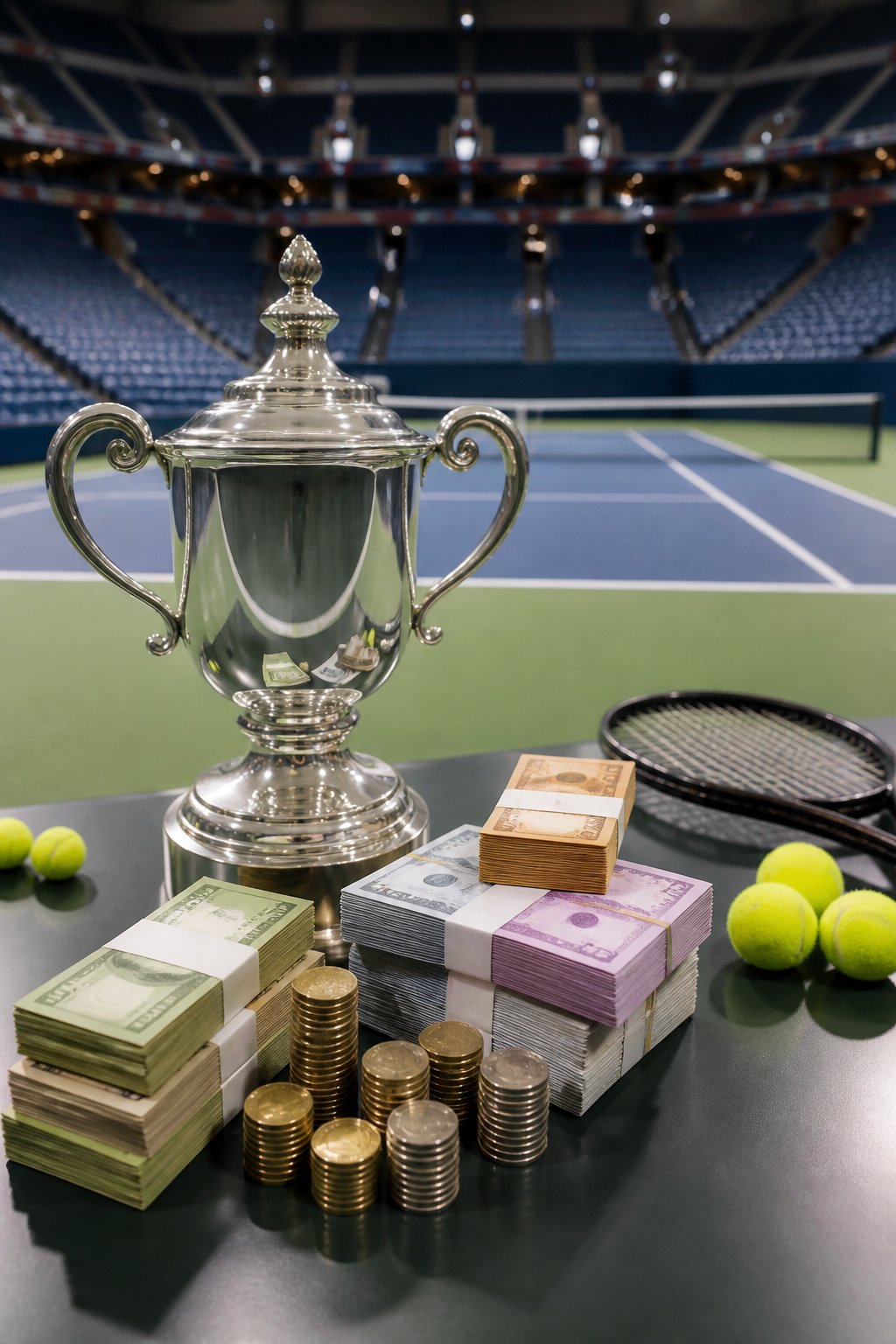
An ATP 250 event typically has a total purse of about $700,000 to $800,000, though it can vary each year and by tournament. Your earnings depend on whether you play qualifiers, win main-draw matches, or play doubles.
Tournament organizers pull together the purse from sponsors, venue partners, ticket sales, hospitality, broadcast rights, and local support. The ATP approves the financial structure, and the tournament pays players based on the official draw and results.
In 2026, for example, the Brisbane International lists $800,045. The Adelaide International and ASB Classic each list $700,045. The Citi Open sometimes runs as an ATP 500, so don’t use it as a 250 reference point.
The total purse covers singles, doubles, qualifying, and other player payments. It’s not just for the winner. What you actually take home depends on your results, taxes, and any deductions.
Singles Prize Money by Round
Your singles prize money jumps with each round. A typical ATP 250 payout might look like this:
| Result | Typical share of the purse |
|---|---|
| Champion | 14%–16% |
| Runner-up | 8%–9% |
| Semifinalist | 4%–5% |
| Quarterfinalist | 2%–3% |
| Round of 16 | About 1% |
| First-round loser | Less than 1% |
These numbers change a bit every year. A champion at a $700,000 event might get about $100,000–$115,000. First-round losers walk away with a few thousand dollars.
Prize money is different from ranking points and career prize money. Your career total includes everything from ATP events, Grand Slams, Davis Cup, and other competitions.
Doubles and Qualifying Earnings
Doubles payouts use a separate draw and usually pay less per player than singles. The winning team might split about $35,000–$55,000, depending on the purse. Each player gets half, before taxes and expenses.
Qualifying pays less, but it gives you a shot at the main draw and bigger money. Lose in the final qualifying round and you might get a few thousand dollars. Earlier losses pay even less.
Travel, coaching, accommodation, and taxes can eat into your earnings. Competing in Switzerland brings different tax rules than playing in the US or New Zealand.
How ATP 250 Events Compare With Other Tiers

ATP 250s have smaller prize pools, fewer ranking points, and shorter draws than higher-level events. Your earnings and ranking bump up at ATP 500s, Masters 1000s, Grand Slams, and the ATP Finals.
ATP 250 Versus ATP 500 Events
Win an ATP 250 and you get 250 ranking points. ATP 500 winners get 500 points. ATP 500s also pay more prize money at every stage, but the exact numbers change by year and tournament.
Both usually have 32-player singles draws, but ATP 500s attract stronger players. That means tougher early rounds. Even a first-round loser at an ATP 500 might earn more than at a 250, but it depends on the purse and draw.
ATP 250s still matter. They’re a good shot for players to win matches, grab points, and boost their ranking. They can help you get straight into bigger tournaments without going through qualifying.
Masters 1000 and Grand Slam Differences
Masters 1000 tournaments give 1,000 points to the champ and offer much bigger purses than ATP 250s. These include Indian Wells, Miami, Monte-Carlo, Madrid, and Rome.
There’s also the National Bank Open, Cincinnati, Shanghai, and Paris. These events have bigger draws and attract nearly all top players, so getting deep in the draw is a major challenge.
The Grand Slams—Australian Open, Roland Garros, Wimbledon, and the US Open—hand out up to 2,000 points to the winner and the biggest individual purses in tennis. The ATP Finals work differently, with qualification based on season results and points for each win.
Why Rankings Points and Draw Size Matter
Prize money is your immediate reward, but ranking points shape your future. A strong ATP 250 result can help you get into bigger events, skip qualifying, and get a better spot in the draw.
Draw size changes your workload. A 32-player ATP 250 means five wins for the title. Masters 1000s and Slams usually require more matches. Some top players get byes, making their first rounds a bit easier.
| Event level | Champion’s ranking points | Typical role |
|---|---|---|
| ATP 250 | 250 | Ranking growth and match access |
| ATP 500 | 500 | Stronger field and larger purse |
| Masters 1000 | 1,000 | Elite regular-season competition |
| Grand Slam | 2,000 | Highest ranking and prize-money level |
You want to look at both the purse and the points when judging an event. For some players, an ATP 250 title is more valuable than a first-round loss at a Masters 1000.
2026 ATP 250 Examples Across the Calendar
ATP 250 purses change by tournament, location, and currency. In 2026, the Brisbane International lists $800,045. The ASB Classic and Adelaide International show up early in the season, but each uses different tournament categories.
Early-Season Events
January gives a good look at the range. The United Cup lists $11,806,190 in prize money, but it’s a team event, not an ATP 250. The Brisbane International is a true ATP 250 with a purse of $800,045.
The ASB Classic and Adelaide International also run in this window. Both are listed at $700,045 for 2026, though Adelaide appears as an ATP 250 in one table and as a WTA 500 in the women’s schedule. Double-check the category before comparing payouts.
The Australian Open comes after these, but its $111.5 million purse is Grand Slam money, not ATP 250. Only compare ATP 250 totals to other ATP 250 events.
Clay and Grass-Court Events
Spring brings plenty of clay-court ATP 250s. The Gonet Geneva Open is among them, but the 2026 table doesn’t show its total purse. Don’t use its 2024 figure for 2026.
The same goes for the Qatar ExxonMobil Open and Dubai Duty Free Tennis Championships. Their earlier prize-money pages pop up in searches, but there’s no confirmed 2026 ATP 250 total for either.
Wimbledon 2026 is a Grand Slam, so its prize money doesn’t reflect ATP 250 averages. The surface might change your travel or schedule, but it doesn’t set a fixed ATP 250 payout.
Hard-Court Events Before the US Open and Asian Swing
North America’s hard-court season includes the Citi Open, National Bank Open, and Cincinnati Open. Not all of these are ATP 250s, so check the event level before using its purse in your average.
The same idea applies during the Asian swing. The China Open and Japan Open Tennis Championships have appeared as higher-tier ATP events, not standard ATP 250s in the current data. Keep their prize money out of ATP 250 averages.
For a real average, only count confirmed 2026 ATP 250 totals, like Brisbane’s $800,045. Don’t mix in ATP 500, Masters 1000, Grand Slam, team, or women’s tour figures.
What Prize Money Means for Players
An ATP 250 payout is your gross tournament income, not take-home pay. What you keep depends on taxes, travel, coaching, training, entry fees, ranking, and any endorsement deals you land.
Gross Earnings, Taxes, and Tour Expenses
Win an ATP 250 and you get the listed singles prize money before deductions. You might owe tax in the tournament’s country and again at home, depending on tax rules and credits.
Expenses keep piling up during the event. Flights, hotels, meals, coaches, fitness staff, medical care, stringing, equipment, agents, and insurance all take a bite. If you’re lower-ranked, you might pay for qualifying and travel without even making the main draw.
The ATP’s baseline program helps some players outside the top ranks. For 2024, the guaranteed minimums were £300,000 for the top 100, £150,000 for ranks 101–175, and £75,000 for ranks 176–250. The ATP covers any shortfall when certain conditions are met. ATP and WTA prize-money breakdowns show tournament-level figures, but they don’t reveal each player’s personal expenses or taxes.
Prize Money Leaders and Career Context
Your singles prize money can jump if you reach Masters 1000s, Grand Slams, or the ATP Finals. Top ATP earners like Jannik Sinner, Carlos Alcaraz, Novak Djokovic, Alexander Zverev, Daniil Medvedev, and Taylor Fritz rack up big totals with deep runs at these events.
Players such as Alex de Minaur, Ben Shelton, and Flavio Cobolli can also boost their earnings with regular main-draw appearances and a better ranking. Still, one good season doesn’t guarantee financial security. You have to think about career prize money, future results, taxes, and the costs of staying on tour.
ATP prize money leaderboards for 2026 can change fast over the season. These lists only show tournament winnings, not total income or profit.
On-Court Winnings Versus Endorsements
Prize money rewards you for how you perform in tournaments. Endorsements, on the other hand, pay you for your commercial appeal, like wearing certain clothes, using specific racquets, showing off watches, or even just showing up at events.
Top players—think Jannik Sinner, Carlos Alcaraz, Novak Djokovic, and Alexander Zverev—often land huge global endorsement deals. Their high rankings and big results mean brands want to reach fans far beyond just tennis.
If you’re ranked outside the top group, you’ll probably earn less from endorsements, even if you play a lot of ATP 250 events. Appearance fees can add to your income, but they’re not the same as prize money and depend on your agreements. For more on how tournament payouts work, check out ATP tournament prize-money structures.
Frequently Asked Questions
An ATP 250 singles champion usually gets about $100,000 to $150,000. First-round losers often walk away with $7,000 to $8,000, but these numbers change depending on the tournament, year, and draw size.
How much prize money does the winner of an ATP 250 tournament receive?
You can expect an ATP 250 singles champion to pocket around $100,000 to $150,000. For example, the 2026 Brisbane International has a total prize pool of $800,045, but the winner’s share depends on that year’s official breakdown.
That’s the gross prize money. After taxes, coaching, travel, training, agent fees, and other expenses, the actual take-home amount drops quite a bit.
What is the typical prize money breakdown for each round of an ATP 250 event?
Here’s a rough breakdown for singles:
- Champion: $100,000–$150,000
- Runner-up: $60,000–$80,000
- Semifinalist: $30,000–$45,000
- Quarterfinalist: $15,000–$25,000
- Second round: $8,000–$13,000
- First round: $5,000–$8,000
These are ballpark figures, not fixed numbers. If you want up-to-date details, check the 2026 ATP prize money breakdown.
How has ATP 250 prize money changed over the years?
Prize pools at ATP 250 events have mostly gone up over time as tournaments bring in more revenue from TV deals and sponsors. The 2026 ATP calendar, for instance, shows $700,045 for Adelaide and $800,045 for Brisbane.
If you’re comparing numbers, always look at the same tournament and factor in changes like draw size or currency. Sometimes the total prize pool grows, but the winner’s share doesn’t jump by the same amount.
How does ATP 250 prize money compare with ATP 500 and ATP Masters 1000 events?
ATP 250s offer the smallest prize pools on the main ATP Tour. For example, the 2026 Dallas Open (an ATP 500) lists $2,833,335, while Brisbane (an ATP 250) has $800,045.
Masters 1000 events pay even more than ATP 500s, and Grand Slams are in a league of their own. Your ranking and results matter, too, since bigger tournaments mean more points and more money.
Do ATP 250 players receive prize money if they lose in the first round?
Yes, you still get paid if you lose in the first round of the main draw. Usually, that’s between $5,000 and $8,000, though each tournament sets its own amount.
If you lose in qualifying, you might get a smaller payment. Keep in mind, though, that travel, hotels, meals, coaching, and team costs can eat up most of your prize money at this level.
How much prize money do ATP 250 doubles champions earn?
Doubles champions at ATP 250 tournaments usually split a team prize of around $30,000 to $50,000. Each player walks away with roughly $15,000 to $25,000 before taxes and expenses.
The actual amount can shift a bit, depending on the tournament’s total purse and how they divide it up. If you want more event-specific details, check out the ATP and WTA prize money tables.